
ISSN: 2977-814X
ISSUE DOI: https://doi.org/10.51596/sijocp.v4i1 Volume 4 Issue 1
Radon as a Particular Danger When Working From Home
Iris M. Reuther, Fachbereich BGG, Jade Hochschule Oldenburg, Germany https://orcid.org/0009-0001-0537-5376

@2024 Iris M. Reuther
Published by SPACE Studies Publications owned by SPACE Studies of Planning and Architecture Ltd.
To cite this article:
Reuther, I. M. (2024). Working Fom Home as a Risk: Radon as a Particular Danger When Working From Home. SPACE International Journal of Conference Proceedings , 4(1), 34–42. https://doi.org/10.51596/sijocp. v4i1.46
This article is an open access article distributed under the terms and conditions of the Creative Commons Attribution(CC BY) license

This article is published at journal.spacestudies.co.uk by SPACE Studies Publications.



ISSN: 2977-814X
ISSUE DOI: https://doi.org/10.51596/sijocp.v4i1 Volume 4 Issue 1
Radon as a Particular Danger When Working From Home
Iris M. Reuther, Fachbereich BGG, Jade Hochschule Oldenburg, Germany https://orcid.org/0009-0001-0537-5376

Received November 13, 2023
Accepted April 22, 2024
Published Online July 31, 2024
https://doi.org/10.51596/sijocp.v4i1.46

Abstract
While being paid to work from home in Germany had been something of an exception for years, the rules on social contact suddenly changed in March 2020 as part of COVID measures. Consequently, the percentage of employees working from home increased from 10% to around 25%. More than three years later, this figure has not significantly reduced, and some assume that many employees will now work from home permanently. This seems to work well for certain jobs and, despite some criticism, clearly offers practical and/or economic advantages for both employees and employers. While working from home might once have been considered a temporary measure, it has now become a permanent workplace, subject to workplace regulations, even if only used part-time. As a result, workplaces in Germany must meet certain legal requirements.
One exception, however, is the potential of a not insignificant health risk for employees. Since 2021, workplaces in so-called radon precautionary areas have been required to be monitored. If these measurements indicate increased exposure to this radioactive noble gas, action is required. However, this is not an obligation for employers of staff working from home, as it would be if they were working from the company premises.
Based on the literature, the problem is presented in three aspects. The combination of these points makes the risk mentioned clear. The full text of this publication explains the situation briefly outlined here, outlines the potential risk to employees, and provides a step-by-step guide on how to recognise it yourself and take action.
Keywords: radon, working from home, health risk, workplace

Introduction
This text addresses a situation that is particularly relevant in Germany due to several factors. Methodologically, this is initially an overview of relevant literature from three areas. The results of this research are then combined to yield the core thesis of this article. Section 2 presents these factors, categorised into three subject areas and verified through reference to publications. Section 3 explains why this combination of factors possibly results in an increased health risk. It also provides advice for planners and building owners who wish to protect themselves from the
Corresponding Author: Iris M. Reuther, Fachbereich BGG, Jade Hochschule Oldenburg, Germany iris.reuther@jade-hs.de
harmful effects of the radioactive noble gas radon. This is not the only reason that the contents of this article are also applicable to other countries.
Factors Affecting the Risks
The following factors are partly relevant in the international context and partly only in the national context. These are, firstly, the general lack of knowledge and the resulting underdeveloped awareness of the risk of radon exposure. Secondly, the legal framework in Germany was introduced relatively recently and is inadequate. The third factor, on the other hand, is not a German phenomenon: this is the increase in working from home since 2020, which has remained unchanged even after the end of restriction measures put in place during the COVID-19 pandemic.
Knowledge and Awareness
Radon is a geogenic, colourless, odourless and tasteless radioactive noble gas. Although it can have a healing effect in low doses, it is generally considered harmful. Specifically, it has been known for years to be the second most common cause of lung cancer after smoking. Recently, other diseases have also been linked to increased radon exposure. Examples include respiratory diseases (Nyhan, et al., 2019), chronic obstructive pulmonary disease (COPD) (Wang, et al., 2024) or (Romero-Gutierrez, et al., 2024) asthma (Mukharesh, et al., 2022) in addition to increased mortality (Banzon, et al., 2023), leukaemia in general (Klokov, et al., 2022) and specifically in children (Tong, et al., 2012), as well as COVID-19 (Reuther, 2022) or (Reuther, 2023). The fact that the aforementioned diseases are a potential consequence of radon exposure is only known to experts. Even the carcinogenic effect of radon on the lungs, which has been considered verifiable for years, is only mentioned as a side note in medical textbooks (here, for example, (Bösch, 2014), (Montag, 2020) and (Kreuter, Herth, Costabel, & Kirsten, 2022)). Exposure to radon is prevented by applying certain construction measures to parts of the building that are in contact with the ground. In German-speaking countries, the relevant information only appears in the latest versions of general textbooks on building construction (e.g. (Hestermann & Rongen, 2015)) or is entirely lacking (e.g. (Pech & Pöhn, 2018) or (Vogdt, et al., 2022)). So far, only a small amount of specialist literature exists on the topic (e.g. (Gertis, 2008) or (Breckow, et al., 2023)). The Federal Office for Radiation Protection itself only set up a geoportal dealing with radon exposure in 2017 (Bundesamt für Strahlenschutz, 2017). It first published a handbook on the subject in 2019 (Bundesamt für Strahlenschutz, 2019) and first published measurement results from recent years in 2022 (Bundesamt für Strahlenschutz, 2022). Other Western countries are ahead of Germany in this respect (Kemski & Uhlig, 2019). In summary, knowledge of the dangers of radon remains limited, even among medical and construction experts. Despite occasional references to radon in low-threshold media (e.g., (Focus online, 2021)), the German population’s awareness of this risk can generally be assumed to be very low.
Legal Framework Conditions
Is the lack of knowledge and awareness mentioned in section 2.1 due to the fact that radon levels are only high in certain regions of Germany? Or is it because increased radon levels can have a detrimental effect on property values, and remediation can be costly? In any case, the abovementioned lack of awareness is reflected in the comparatively recent legislation on the topic, which is also limited in its application. In December 2013, the EU issued the European Directive 2013/59/Euratom, which defines “basic standards” for the protection of the health of workers and the general public against the dangers arising from ionising radiations (Official Journal of the European Union, 2013). Article 103 of the directive stipulates that member states must each establish a “national action plan to address the long-term risks of radon exposure [including] in dwellings”. The Radiation Protection Act (“Strahlenschutzgesetz”) came into force in Germany on 1 October 2017. Section 124 refers generally to dwellings, whereas Section 126 explicitly deals with workplaces (Bundesministerium der Justiz, 2017). The reference value of 300 Bq / m³ indoor air as an annual average was adopted from the Euratom Directive without adaptation. The obligation to measure and report radon levels in so-called radon precautionary areas (“Radonvorsorgegebiete”) only applies to workplaces, however. The federal states were responsible for designating the aforementioned areas by the end of 2020. Only six of the 16
federal states have designated such areas. They are characterised by the fact that the above-mentioned reference value is “exceeded with above-average frequency” (Bundesamt für Strahlenschutz, 2021). The maps in Figure 1 show (on the left) the designated radon precautionary areas in Germany and (on the right) the average indoor radon activity concentration in each district as of 2006, marked in colour. Simply making a rough comparison of the proportion marked in dark colours on both maps shows that not all regions expected to have high indoor radon concentrations have been declared precautionary areas; far from it. This may be due to the fact that Section 153 of the Radiation Protection Ordinance (“Strahlenschutzverordnung”) allows the federal states to choose between various criteria. For example, some federal states defined areas by municipality (e. g. in Baden-Württemberg) and others by district (e. g. in Bavaria).
The second aspect of this section is the legal reference to utilisation. Germany currently has around 19 million residential buildings and around 2 million heated non-residential buildings (Becker, Hagen, Krüger, & Exner, 2022). Most of these non-residential buildings accommodate workplaces. These buildings containing workplaces, which account for less than 10% of the building stock, are the only buildings subject to mandatory radon measurement and reporting by employers.
In combination with the low proportion of radon precautionary areas and the restriction of radon monitoring to workplaces, it can be concluded that the legal situation with regard to protecting the population from radon is inadequate.
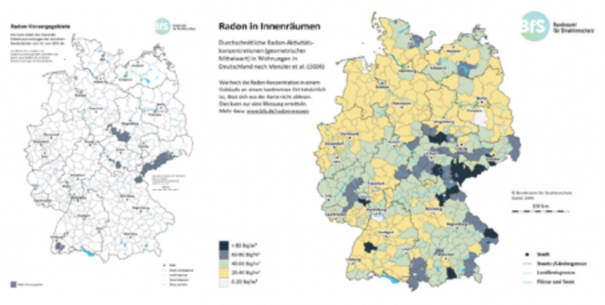
Figure 1. Radon precautionary areas in Germany (according to (Bundesamt für Strahlenschutz, 2021) left) and indoor radon levels (according to (Bundesamt für Strahlenschutz, 2006) right).
Increase in Working From Home as a Result of COVID-19 Measures
Part of the COVID-19 measures in Germany included recommending, and ultimately obliging, people to work from home, telework or work remotely (these terms are not differentiated here, as this is irrelevant in terms of content). Non-compliance was punishable by fines (Die Bundesregierung;, 2022). Accordingly, the proportion of people working from home rose from around 11-13% in 2017-19 to 21% in 2020 and almost 24% in 2021 (destatis - Statistisches Bundesamt, 2022), (destatis - Statistisches Bundesamt, 2023). After the majority of COVID-19 measures ended, the proportion of people working from home fell only slightly (statista - Statista Research Departement, 2023). Frequently cited reasons for this include the opportunity to save time and money by not having to commute, as well as greater flexibility. Lack of contact with colleagues is the most frequently cited stressful aspect of working from home, followed by lack of exercise and the blurring of boundaries between work life and private life, at 50%, 34% and 31% respectively (statista - Statista Research Departement, 2023). By relocating workplaces to
employees’ private dwellings, employers can save on office space and thus make long-term cost savings. Nevertheless, most employers are gradually recalling their employees to the office because they have recognised working from home as a reason for reduced productivity, among other things (Tyson, 2023). However, hybrid working, i. e. part-time working from home, appears to have established itself as popular and practicable for employees and employers alike in the relevant sectors and in varying proportions. Current studies therefore assume that at least partial working from home will continue to be common in the future (Tsipursky, 2023), (statista - Statista Research Departement, 2023), (Becker, Thörel, Pauls, & Göritz, 2022).
Result and Available Information
The combination of factors mentioned in section 2 can sometimes result in an increased yet little-known health risk to the population, which is explained below. This section also shows how this risk can be reduced.
Result: Increased Health Hisk, But Little Information
The factors mentioned in section 2 can be summarised as follows. Exposure to radon is the second most common cause of lung cancer. Current research suggests that this radioactive noble gas could favour the development of other diseases as well. Nevertheless, knowledge of this is not widespread in German-speaking countries, neither in the medical field nor the construction industry, the areas where preventative radon protection measures are in place. The legal framework in Germany only stipulates an obligation to measure indoor radon concentrations in a handful of areas, and even here, the obligation is restricted to employers in workplaces. In contrast, when working from home, the employees themselves are responsible for their workplaces, without any checks being carried out on their potential increased exposure to radon. As a result of COVID-19 measures, the proportion of employees working entirely or partially from home has increased significantly. There is currently no indication that this proportion will fall back to pre-2020 levels.
This means that, since 2020, more people have been working in a potentially unhealthy environment without realising it. Why is this? This is due to the location of home offices often occupying detached houses and being in the basement. As far back as 2008, 22% of homeowners who renovated their basements cited creating an office space as the purpose of the renovation (Stölb, 2008). This percentage is likely to have increased considerably during COVID-19 measures. Radon is a geogenic noble gas, meaning that it enters buildings through building components that are in contact with the ground. Therefore, people living in older buildings in contaminated areas increase their exposure to ionising radiation if they spend more time in the basement. The author is convinced that the usual residential use of the basement is rare, but the use of the basement for home offices is not.
In the absence of mandatory measurement and reporting requirements for home offices, and due to the lack of awareness about the issue among the general population, the increase in people working from home therefore means that society as a whole is at increased risk of illness due to radon exposure.
A selection of low-threshold Internet guides on the subject of basement renovation shows that most of the information provided does not focus on protecting against radon. Instead, it focuses on the market value of converted basements (Stölb, 2008), the requirements for a home office in your basement to be tax-deductible (Rudolph, 2015), insulation and lighting considerations when installing an office in your basement (Hörmann Zimmertüren, n. d.), lighting and planning permission in such cases (Elektro Hoffmann, 2020), potentially also waterproofing or draughtproofing (Konkel, 2021) and heating (Innotech GmbH, n. d.). An ergonomics and health website offers tips on how to choose lighting and furniture for basement conversions (ergonomisch gesund, n. d.). Even tips from a building society fail to mention potential radon exposure (Mein Zuhause, 2017).
It was not until February 2021, almost a year after the first lockdown in Germany, that the Federal Office for Radiation Protection warned of the risk of radon exposure for people working from home in basement offices (Stölzel, 2021), (Sieben, 2021). However, this warning wasn’t actually published by specialist media sources in the IT sector, in which home offices are particularly
prevalent, until early 2023 (Adam, 2023). In some media the warning was also greatly abbreviated, or the facts were presented in a very simplified manner. More serious media outlets did at least explain that although panic wasn’t justified, radon measurement was (Stölzel, 2021). Would this recommendation be followed? Although one international radon measurement company did note an increase in demand in 2021, it believes this was due to increased health awareness (Nielsson, 2021).
Experts in the field of radon protection (the author of this article is certified as a radon specialist) know that rooms in basements are not necessarily contaminated with radon. Conversely, rooms on the ground floor can also be contaminated, especially in buildings without basements. Even rooms on upper floors can deliver measurements far above the reference value. Limiting information on radon protection to basements alone is therefore not enough from a technical point of view. But what can be achieved through remedial action?
Recommendations for People Working From Home
The first measure requires little effort: thorough airing of rooms on a regular basis, although this is not always possible in basements. However, airing rooms regularly is advisable in any case, regardless of radon exposure. New buildings should be completely waterproofed against ground moisture – this also prevents the ingress of radon from the ground. In existing buildings, leaks should be identified and remedied (Sieben, 2021). Identifying leaks requires expert intervention; some homeowners shy away from the cost and effort involved.
Recommendations for Building Planners
In new buildings, the usual moisture protection measures are usually sufficient against radon. But if there are doubts in existing buildings, action should be taken. In such cases, the author therefore recommends an inexpensive starting point: using an exposimeter to take long-term measurements. Although exposimeter readings must be taken for a year – as the term “long-term measurements” suggests – this is both the only measurement method permitted by law in radon precautionary areas and very cost-effective: radon exposure can be determined for around 30 – 40 euros per measuring point (as of 2023).
Short-term measurements carried out by a specialist are only required in addition to or before the results of the long-term measurement in regions where high radiation levels can be expected based on the geological maps and in buildings constructed before around 1970, in rooms in contact with the ground.
Measuring radon levels (whether long-term or short-term) is the only way to gather reliable data as to whether there is any reason to take action at all. A limitation of this publication is obvious: it cannot provide a meaningful description of what actions should be taken, as the structural situations are too varied and the subject matter too complex.
Recommendations for Science and Society
With regard to the health consequences of the COVID-19 measures, several publications have long documented a significant increase in mental illness. The WHO itself stated this in mid-2022 (tagesschau, 2022). With regard to physical illnesses, in addition to the lack of preventative medical check-ups and the consequences of this, a lack of exercise is also not uncommon [e.g. in (Interministerielle Arbeitsgruppe, 2023)]. The author of this article has found only one recent publication reporting an increase in radon-induced diseases in Canadian children and adolescents (Cholowsky, et al., 2023). From this, she has concluded that there is currently still a considerable need for scientific research on this topic. The author believes that all specialist disciplines involved must be called upon to do their part.
However, it is not only research that is needed, but also raising public awareness. Some people may even be reluctant to take measurements because high radon levels have considerable economic disadvantages for building owners. It was not until August 2023 that the Free State of Saxony became the first federal state to decide to provide financial support for radon remediation measures (Sächsisches Staatsministerium für Energie, Klimaschutz, Umwelt und Landwirtschaft, 2023). This federal state is thus signalling that it places value and importance on protecting
people’s health.
During the COVID-19 pandemic, the German federal government and state governments showed great concern for people’s health. The author therefore hopes that the inadequate measures protecting against the health consequences of radon exposure described in section 2.2 are merely a temporary state of affairs, hopes that the obligation to measure and report radon levels is promptly extended, and that extensive financial support is provided for health protection measures, as was made possible during the pandemic.
Conclusions
It is becoming apparent that exposure to radon causes more types of illness than previously assumed. At the same time, particularly in Germany, there is still room for improvement in terms of knowledge about radon exposure and legal regulations for protecting people from this radioactive noble gas. As a result of the increase in working from home as part of COVID-19 measures, exposure to radon has increased in society as a whole, but this has received little attention. In the interests of health protection, more attention should be paid to the topic. This publication contributes to doing just that.
Conflict of Interests
No potential conflict of interest was reported by the author(s).
Biographical notes on authors
Iris M. Reuther studied Architecture at Würzburg University of Applied Sciences, followed by further study at the University of Stuttgart and the KTH in Stockholm. She graduated with distinction. The author holds a Doctoral degree in Architecture from Graz University of Technology. Her PhD study was supported by several scholarships. She is both an expert in building damage and radon. Iris M. Reuther has almost 20 years of practical experience, in particular in property surveillance for health service buildings. Since 2022, she has been a full professor of building construction at Jade Hochschule Oldenburg, Germany.
Endnotes
This paper has been presented at the SPACE International Conference 2023 on Architecture Building and Construction
References
Adam, S. (01.02.2023). Warnung vom Strahlenschutz: Warum Sie kein Homeoffice im Keller machen sollten. (BurdaForward GmbH, Herausgeber) Last accessed 06.11.2023 from Chip365: https://www.chip.de/news/Warnung-vom-Strahlenschutz-Warum-Sie-kein-Homeoffice-im-Keller-machen-sollten_183302713.html
Banzon, T. M., Greco, K. F., Li, L., Mukharesh, L., Zilli Vieira, C. L., Steiner, K. M., Gaffin, J. M. (2023). Effect of radon exposure on asthma morbidity in the School Inner-City Asthma study. Pediatric pulmonology, S. 2042–2049. doi:https://doi.org/10.1002/ppul.26429
Becker, C., Thörel, E., Pauls, N., & Göritz, A. S. (19.04.2022). Homeoffice in Corona-Zeiten – Sind Ausmaß und/oder Flexibilität wichtig für Arbeitszufriedenheit, soziale Unterstützung, Commitment und Arbeitsunterbrechungen? Gruppe. Interaktion. Organisation., p. 173–187. doi: https://doi. org/10.1007/s11612-022-00630-z
Becker, S., Hagen, J., Krüger, R., & Exner, A. (10 / 2022). DENA Gebäudereport 2023. (Deutsche Energie-Agentur GmbH, Hrsg.) Last accessed 3.11.2023 from https://www.dena.de/fileadmin/ dena/Publikationen/PDFs/2022/dena_Gebaeudereport_2023.pdf
Bösch, D. (2014). Lunge und Atemwege. (T. F. Lüscher, & J. Steffel, Hrsg.) Berlin Heidelberg: Springer-Verlag. doi: https://doi.org/10.1007/978-3-642-28223-2
Breckow, J., Hartmann, T., Kemski, J., Kleve, G., Klingelhöfer, G., & Leicht, K. (2023). Radon und Radonschutz im Bauwesen. (G. Klingelhöfer, & K. Leicht, Hrsg.) Stuttgart: Fraunhofer IRB Verlag.
Bundesamt für Strahlenschutz. (2006). Radon in Innenräumen in Deutschland. Last accessed
4.11.2023 from https://www.bfs.de/DE/themen/ion/umwelt/radon/karten/innenraeume.html
Bundesamt für Strahlenschutz. (2017). Geoportal. Last accessed 08.07.2023 from https://www. imis.bfs.de/geoportal/
Bundesamt für Strahlenschutz. (2019). Radon-Handbuch Deutschland. Salzgitter. Last accessed 14.07.2022 from https://www.bfs.de/SharedDocs/Downloads /BfS/DE/broschueren/ion/radon-handbuch.pdf? blob=publicationFile&v=10
Bundesamt für Strahlenschutz. (15.06.2021). Radon-Vorsorgegebiete in Deutschland. Last accessed 03.11.2023 from https://www.bfs.de/DE/themen/ion/umwelt/radon/karten/vorsorgegebiete.html
Bundesamt für Strahlenschutz. (25.01.2022). Radon im Boden: Neue Karte gibt Orientierung. Last accessed 15.07.2022 from https://www.bfs.de/SharedDocs/Pressemitteilungen/BfS/ DE/2022/001.html
Bundesministerium der Justiz. (05 / 2017). Gesetz zum Schutz vor der schädlichen Wirkung ionisierender Strahlung. (Bundesrepublik Deutschland, Herausgeber) Last accessed 03.11.2023 from https://www.gesetze-im-internet.de/strlschg/
Cholowsky, N. L., Chen , M. J., Selouani, G., Pett, S. C., Pearson, D. D., Danforth, J. M., Goodarzi , A.
A. (2023). Consequences of changing Canadian activity patterns since the COVID-19 pandemic include increased residential radon gas exposure for younger people. nature portfolio. doi: https:// doi.org/10.1038/s41598-023-32416-
destatis - Statistisches Bundesamt. (14.06.2022). Ein Viertel aller Erwerbstätigen arbeitete 2021 im Homeoffice. Last accessed 03.11.2023 from Zahl der Woche Nr. 24 vom 14. Juni 2022: https:// www.destatis.de/DE/Presse/Pressemitteilungen/Zahl-der-Woche/2022/PD22_24_p002.html
destatis - Statistisches Bundesamt. (11.07.2023). Knapp ein Viertel aller Erwerbstätigen arbeitete 2022 im Homeoffice. Last accessed 04.11.2023 from Zahl der Woche Nr. 28 vom 11. Juli 2023: https://www.destatis.de/DE/Presse/Pressemitteilungen/Zahl-der-Woche/2023/PD23_28_ p002.html
Die Bundesregierung;. (22.01.2022). Corona-Schutz am Arbeitsplatz: Das sind die aktuellen Regeln. (Bundesrepublik Deutschland, Herausgeber) Last accessed 04.11.2023 from https:// www.bundesregierung.de/breg-de/themen/coronavirus/infektionsschutz-arbeitsplatz-1983894
Elektro Hoffmann. (15.06.2020). Kellerausbau. Last accessed 04.11.2023 from https://www. elektro-hoffmann.de/kellerausbau/
ergonomisch gesund. (n. d.). Last accessed 04.11.2023 from Büro im Keller oder Lagerraum: Ergonomisches Arbeiten ermöglichen
Focus online. (15.04.2021). Große Radon-Karte: Wo Sie sich in Deutschland vor dem gefährlichen Gas wappnen müssen. Last accessed 14.07.2022 from https://www.focus.de/gesundheit/news/ zweitgroesstes-risiko-fuer-lungenkrebs-gefahr-aus-dem-boden-diese-karte-zeigt-wo-sie-sich-vor-radon-schuetzen-muessen_id_11064690.html
Gertis, K. (2008). Radon in Gebäuden. (Fraunhofer-Institut für Bauphysik, Hrsg.) Stuttgart.
Hestermann, U., & Rongen, L. (2015). Frick/Knöll Baukonstruktionslehre 1 (36. Ausg.). Wiesbaden: Springer Vieweg. doi: https://doi.org/10.1007/978-3-8348-2565-0
Hörmann Zimmertüren. (n. d.). Kellerausbau: Arbeitsplatz fern der Hektik. Last accessed 04. 11.2023 from bauemotion: https://www.bauemotion.de/magazin/kellerausbau-arbeitsplatz-fern-der-hektik/15002577/
Innotech GmbH. (n. d.). Büro im Keller einrichten – Platz fürs Home Office. Last accessed 04.11.2023 from https://www.innotech-team.de/buero-im-keller-einrichten-was-tun-wenn-ploetzlich-ein-platz-fuers-home-office-benoetigt-wird/
Interministerielle Arbeitsgruppe. (08.02.2023). Abschlussbericht: Gesundheitliche Auswirkungen auf Kinder und Jugendliche durch Corona. (Die Bundesregierung, Hrsg.) Last accessed 05.11.2023 from https://www.bmfsfj.de/resource/blob/214866/ fbb00bcf0395b4450d1037616450cfb5/ ima-abschlussbericht-gesundheitliche-auswirkungen-auf-kinder-und-jugendliche-durch-
Kemski, J., & Uhlig, W.-R. (09.11.2019). Erarbeitung von DIN-Normen bzgl. baulicher Maßnahmen für den Radonschutz. (Bundesamt für Strahlenschutz, Hrsg.) Salzgitter. Last accessed 3.11.2023
Klokov, D., Applegate, K., Badie, C., Brede, D. A., Dekkers, F., Karabulutoglu, M., Gomolka, M. (2022). International expert group collaboration for developing an adverse outcome pathway for radiation induced leukemia. International journal of radiation biology. doi: https://doi.org/10.1080/0955300 2.2022.2117873
Konkel, R. (2021). Homeoffice? Jetzt Platz im Keller nutzen! Last accessed 04.11.2023 from https:// rkwerterhaltung.de/homeoffice-jetzt-platz-im-keller-nutzen/
Kreuter, M., Herth, F. J., Costabel, U., & Kirsten, D. (2022). Seltene Lungenerkrankungen. Berlin: Springer. doi: https://doi.org/10.1007/978-3-662-63651-0
Mein Zuhause. (2017). Kellerausbau: Das tiefergelegte Büro. Last accessed 04.11 2023 from Das online Magazin von Wüstenrot: https://www.mein-leben.at/mein-zuhause/kellerausbau-das-tiefergelegte-buero.html
Montag, G. (2020). Facharztprüfung Pneumologie. Berlin: Springer. doi: https://doi.org/10.1007/978-3-662-61574-4
Mukharesh, L., Greco, K. F., Banzon, T., Koutrakis, P., Longxiang, L., Hauptman, M., Gaffin, J. M. (2022). Environmental radon and childhood asthma. Pediatric pulmonology, S. 3165–3168. doi: https://doi.org/10.1002/ppul.26143
Nielsson, K. (01.11.2021). Wie haben sich durch COVID-19 die Voraussetzungen für Radonmessungen verändert? Last accessed 06.11.2023 from https://radonova.de/wie-haben-sich-durch-covid-19-die-voraussetzungen-fuer-radonmessungen-veraendert-2/
Nyhan, M. M., Rice, M., Blomberg, A., Coull, B. A., Garshick, E., Vokonas, P., Koutrakis, P. (2019). Associations between ambient particle radioactivity and lung function. Environment international. doi: https://doi.org/10.1016/j.envint.2019.04.066
Official Journal of the European Union. (5. 12. 2013). RICHTLINIE 2013/59/EURATOM DES RATES. Last accessed 3.11.2023 from Richtlinien: https://eur-lex.europa.eu/legal-content/DE/TXT/ PDF/?uri=CELEX:32013L0059&from=en
Pech, A., & Pöhn, C. (2018). Baukonstruktionen Band 1 - Bauphysik (2. Ausg.). Basel: Birkhäuser.
Reuther, I. M. (2022). Study of relationship between indoor radon exposure and the Covid-19 case fatality rate. (AIP Publishing, Hrsg.) Conference Proceedings: World Multidisciplinary Civil Engineering-Architecture-Urban Planning Symposium - WMCAUS 2022, p. 070020-1 -070020-7. doi: https://doi.org/10.1063/5.0171451
Reuther, I. M. (2023). A closer look: additional study of relationship between indoor radon exposure and the Covid-19 case fatality rate. Last accessed 03.11.2023 from https://wmcaus.org/files/ WMCAUS2023_Book.pdf
Romero-Gutierrez, C., Koutrakis, P., Liu, M., Zilli Vieira, C. L., Coull, B. A., Maher, E. F., Garshick, E. (2024). Radon decay product particle radioactivity and oxidative stress biomarkers in patients with COPD. Environmental research. doi: https://doi.org/10.1016/j.envres.2023.117505
Rudolph, T. (03.03.2015). Arbeitszimmer im Keller? So berechnen Sie die Kosten richtig! Last accessed 04.11.2023 from LohnsteuerKompakt: https://www.lohnsteuer-kompakt.de/ steuerwissen/arbeitszimmer-im-keller-so-berechnen-sie-die-kosten-richtig/
Sächsisches Staatsministerium für Energie, Klimaschutz, Umwelt und Landwirtschaft. (28.08.2023). FRL Stadtgrün, Lärm, Radon/2023. Last accessed 06.11.2023 from https://revosax. sachsen.de/vorschrift/20206#t4
Sieben, P. (16.02.2021). Homeoffice: Diese Räume sollten Sie meiden. (VDI Verlag GmbH, Hrsg.) ingenieur.de. Last accessed 04.11.2023 from https://www.ingenieur.de/karriere/arbeitsleben/ arbeitssicherheit/homeoffice-diese-raeume-sollten-sie-meiden/
statista - Statista Research Departement. (03 / 2023). Homeoffice und mobiles Arbeiten.
(Statistisches Bundesamt, Hrsg.) Last accessed 04.11.2023 from https://de.statista.com/statistik/ studie/id/86464/dokument/homeoffice-und-mobiles-arbeiten/
Stölb, M. (22.10.2008). Am Keller sparen kann teuer werden. Frankfurter Allgemeine Zeitung. Last accessed 04.11.2023 from https://www.faz.net/aktuell/wirtschaft/wohnen/haus/hausbau-am-keller-sparen-kann-teuer-werden-1709222.html?printPagedArticle=true#void
Stölzel, T. (14.02.2021). Bundesamt für Strahlenschutz warnt vor Homeoffice im Keller. (D. von Holtzbrinck, Herausgeber, & Handelsblatt GmbH, Produzent) Last accessed 06.11.2023 from Wirtschaftswoche: https://www.wiwo.de/technologie/umwelt/unterschaetzte-gefahr-radon-bundesamt-fuer-strahlenschutz-warnt-vor-homeoffice-im-keller/26907286.html
tagesschau. (17.06.2022). WHO-Bericht: Mehr psychische Krankheiten durch Corona. Last accessed 05.11.2023 from https://www.tagesschau.de/ausland/europa/who-corona-anstieg-psychische-krankheiten-101.html
Tong, J., Qin, L., Cao, Y., Li, J., Zhang, J., Nie, J., & An, Y. (2012). Environmental radon exposure and childhood leukemia. Journal of toxicology and environmental health. Part B, Critical reviews, S. 332–347. doi: https://doi.org/10.1080/10937404.2012.6
Tsipursky, G. (02.03.2023). Overcoming the Challenges of Remote Work. Last accessed 04.11.2023 from Psychology Today: https://www.psychologytoday.com/au/blog/intentional-insights/202302/overcoming-the-challenges-of-remote-work
Tyson, J. (20.06.2023). Remote work erodes productivity by 4%: NY Fed. (CFO DIVE, Herausgeber) Last accessed 04.11.2023 from https://www.cfodive.com/news/remote-work-erodes-productivity-4-percent-ny-fed-hr/653427/
Vogdt, F. U., Bredemeyer, J., Fischer, J., Hofmann-Böllinghaus, A., Nisse, J., Schaudienst, F., Walsdorf-Maul, M. (2022). Bauphysik - Grundwissen für Architekten. Wiesbaden: Springer Vieweg. doi: https://doi.org/10.1007/978-3-8348-2189-8
Wang, V. A., Koutrakis, P., Li, L., Liu, M., Z. Vieira, C. L., Coull, B. A., Garshick, E. (2024). Particle radioactivity from radon decay products and reduced pulmonary function among chronic obstructive pulmonary disease patients. Environmental research. doi: https://doi.org/10.1016/j. envres.2022.114492